

Why your paid ads aren’t scaling: 4 challenges that have nothing to do with your ads


Scaling your business with paid ads can be challenging. Even in well-structured ad accounts, advertisers struggle to hit targets or push beyond acquisition & revenue plateaus while staying efficient.
It often feels like no best practice or optimization is enough to move the needle.
So what do you do?
Before shifting your focus to blaming the advertising platforms, I would recommend asking yourself this question:
“Am I set up properly to make the most of my Paid Ads investment?”
That’s a critical question, and although it may seem to be a broad and complex topic, actually, to answer it, you just need to answer 4 questions.
Does this sound interesting? If yes, let’s dive in.

1st Question: Does my UX perform at a high level on all devices?
If your website (or app) is not operating properly, then your ads will not perform well.
Even if you bring the most relevant audience, what can users do to get past a broken “buy button” on a mobile device?
Therefore, it is crucial to identify these glitches as soon as possible. I would suggest two cross-checks:
- Copy and paste your homepage URL into PageSpeed Insights: this is a valid, safe, and free tool from Google that helps you understand your website’s performance.
- Try to fulfil all checkout steps in the mobile version of your website with your phone.
- Write down how many clicks it took you. Also, the kind of feeling that the whole process left you with. Did you feel lost or happy with the experience?
- Do the same for your 4 main competitors. How did you rank vs. the competition from that perspective?

2nd Question: Am I feeding platforms with accurate signals?
Whatever the ad platform, there is always an algorithm behind it. And it’s important to remember that the algorithm needs to get proper training. To do so, you need to share with the system:
“reliable, strategically picked conversion events that represent real, measurable value”.
If you don’t do this, it’s almost impossible to get the most out of your ad spend.
In fact, it’s like asking the platform to throw darts with its eyes closed. It won’t even know what it’s hitting.
Also, unreliable conversion data will probably lead to poor account management decisions.
Tracking is a complex topic that has become more and more challenging. Think of the privacy changes processed by Apple & the EU in recent years. So I would strongly advise you to contact a specialized consultant.
But to get you started, I have a simple health check you can run right away:
- Install Meta Pixel Helper & Google Tag Assistant browser extensions.
- Fulfill the checkout funnel on your website. Every time you proceed to the next step, please check both extensions.
- Count the alerts spotted during your checkout session in both. If you saw a lot of them, it’s time to contact someone.
3rd Question: Are there significant leaks in my offering or business?
That’s a more multidimensional one. At this point, though, I will give you two critical health checks that will help you understand where I am coming from.
- Google your core product or service and observe your competitor’s ads.
What pricing do they communicate? Is it more competitive than yours? Any additional perks for first-time buyers? Even a single tweak in your or your competitor’s offering could significantly affect your Conversion Rate and ad performance.
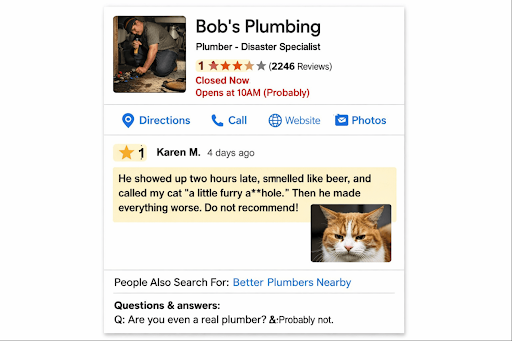
- Check out your business’s reviews on the most reliable platform
That could be Google Business Profiles, Trustpilot, or something different. How many reviews do you have? How do you rank against the competition?
People are really researching nowadays, making conscious and sophisticated decisions. A brand perception healthcheck will possibly reveal a lot about any glitches affecting your performance while users are surpassing that stage.
4th Question: Have I defined my campaign efficiency targets properly?
If you don’t have a specific efficiency target, such as a desired cost for client acquisition (Target CPA) or return on investment (Target ROAS), then your ad accounts can’t be managed properly.
This is because there is no way for the account manager to know:
- whether campaigns are successful or need adjustments.
- the incremental conversions that they leave off the table.
Let me clarify the last one.
Imagine that you have a $100 Target CPA. If your Paid Ads program runs with a $70 actual CPA, then you may be giving up opportunities!
Until you are there, there is no reason to stop scaling (excluding, of course, logistic limitations). So if you don’t run your campaigns without a clear benchmark, how can you make those decisions?
The checklist here is pretty simple:
- Have you defined your proper Target CPA or Target ROAS?
- Have you defined your average LTV per new subscriber?
If not, put out a pencil and paper and start working on this. If you need any support on how to calculate those things properly, feel free to reach out!
To Summarize
While constantly optimizing your ad accounts is necessary for your campaigns to succeed, it’s not enough. A lot of times, the most impactful optimization opportunities can be found outside your accounts interface.
I would strongly recommend that you go through the questions and healthchecks described above. It should take no more than an hour or two, and by the end, you’ll have a clear view of where you stand and what needs to be improved next.
I am pretty optimistic that even a small fix based on those learnings will significantly impact your performance.
